In the continuing quest to observe the sky as never before possible, ASTRON develops novel technologies for radio telescopes that allow astronomers to see farther, faster, and at more frequencies. These same innovations are leveraged for satellite tracking and other remote sensing applications. With the development of the Ambient L-band Feed (ALF), ASTRON is charting a new course where such measurements can be done using less power and requiring less maintenance of the equipment. Recently, first light measurements using the ALF prototype receiver demonstrated the power of this novel technology by revealing a pulsar across a broader range of radio wavelengths than Westerbork has ever measured before.
Published by the editorial team, 7 May 2026
Radio telescopes are both huge but also highly precise instruments. To reveal faint astronomical signals, a radio telescope needs to collect radio waves to a focal point and amplify them so that stars and galaxies pop out against a much larger background of noise and artificial signals from modern technology. Naturally occurring radio signals are incredibly weak: the amount of energy that the telescope detects wouldn't even be enough to lift a feather.
Traditionally, radio telescopes have used cryogenic cooling with liquid Nitrogen or even Helium to reduce electronic noise and to give the most sensitivity possible to astronomical signals. But keeping a radio receiver frozen close to absolute zero takes a lot of power and upkeep. That costs money and time.
Using newly available transistors based on indium-phosphide (InP) - each only the size of a pinhead and connected by razor-thin gold wires - it's possible to amplify the signal without introducing significant noise and without the need for costly cryogenic cooling. At the same time, by integrating the transistor with the antenna and using advanced development tooling, ASTRON has succeeded in building a novel highly optimized receiver system. The ALF receiver surpasses all the previous receivers that the Westerbork telescope has seen in its nearly 60-year history in terms of sensitivity and instantaneous bandwidth
"We started this project with high hopes but knowing that there would be significant challenges too", says Mark Ruiter, one of the engineers working on the project. "Now, with our newly developed prototype working, the performance has exceeded our expectations!"
The team is now working on a few more refinements and a more evolved version of ALF, while the science team is ramping up their astronomical observations using this innovative technology.
"Our first-light measurements of a pulsar give us confidence that the end-to-end system is working", says Nina Gusinskaia, astronomer and Bell-Burnell-prize fellow at ASTRON. "Now our goal is to run ALF for a much longer time and to monitor the skies for rare but powerful explosions called `fast radio bursts'".
Fast radio bursts are flashes of radio waves that last much shorter than the blink of an eye but carry as much energy as the Sun emits in a week's time. Their signals travel to Earth from distant galaxies, located billions of light-years away. How these bursts are generated, and by what kind of extreme star, is still hotly debated by astronomers. By using ALF on a single 25-metre dish from the Westerbork array, the team will search for the very brightest fast radio bursts that nature produces. These ultra-high-energy flashes are key to solving this astrophysical puzzle, and ALF's ability to capture a wide range of radio wavelengths is also critical to success:
"Many theories have been proposed to explain the fast radio burst phenomenon, including magnetic explosions from neutron stars, and black holes that launch powerful jets", explains Nina Gusinskaia. "Using ALF on Westerbork, we aim to detect record-breaking, extremely energetic fast radio bursts and to analyse these signals over a wide range of radio wavelengths. The signal properties at different wavelengths encodes the information we need to understand how fast radio bursts are produced".
Building on their success, the team is also thinking about how to further develop the ALF technology into the future. "ALF is a gamechanger for facilitating low-cost but high-quality radio astronomical observations", says Violette Impellizzeri, head of ASTRON Astronomy & Operations. "We are looking to extend ALF to cover an even broader range of radio frequencies and to use it on a larger number of radio telescopes. This will allow us to study how the most extreme phenomena in nature shape the Universe over cosmic time."
This publication is part of the project Ambient-L with file number OCENW.M.22.443 of the research programme Open Competition Domain Science which is financed by the Dutch Research Council (NWO).
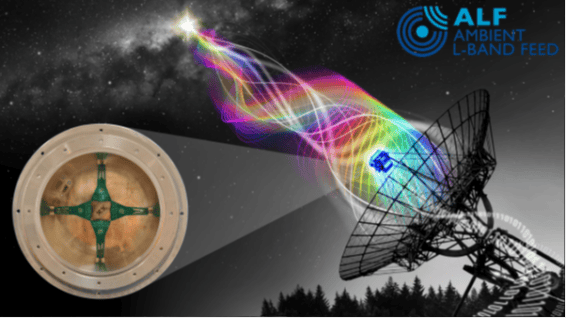
Artist’s depiction of a Westerbork dish receiving radio waves over a broad range of frequencies and converting this astronomical information into a digital signal. The inset shows the `orthogonal mode transducer’ that couples the received radio waves to the electronics that convert this signal into digitised information.
Credit: Daniëlle Futselaar & the ALF Team.
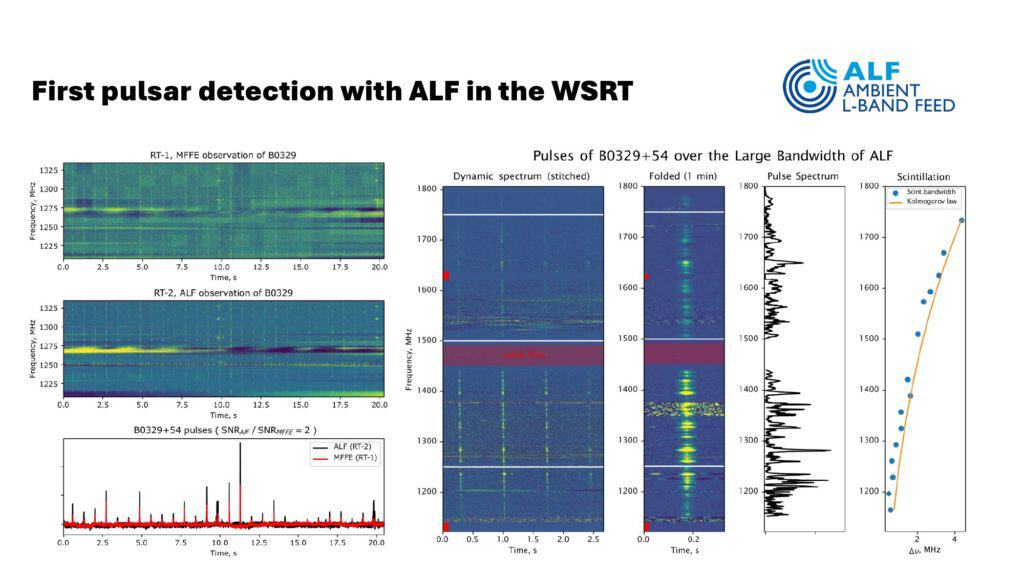
Technical diagrams showing the first-light detection of a pulsar using ALF.
Credit: Nina Gusinskaia & the ALF Team.